
Balance
What first brought me to Pilates?
I fell over. A lot. My partner at the time would regularly take the mick out of me (that’s another story!) and once commented that I was weirdly really graceful and really clumsy at the same time. That would be my background in gymnastics meeting my hypermobility! You would think that a background as a gymnast would lead to me at least being able to walk pretty effectively, but sometimes I think it’s easier walking on my hands than on my feet.
Over the years I have learnt to stabilise my ankles - slowly, regularly building strength and control. And now I don’t fall over any more - well, hardly ever.
There are a myriad of reasons that people can struggle with balance but I think for a lot of people, we become over-reliant on soft, thick-soled shoes that stop our foot muscles and connective tissue from building and retaining the strength they’re supposed to have. The foot is a super complex piece of bio-engineering that needs to be mobile, reactive and stable all at once. Each foot has 26 joints, with 33 bones and over 100 muscles, tendons and ligaments, so there’s a lot of room for things to go wrong. I often think that when it comes to movement dysfunction, and balance in particular, we need to start at the feet and work our way up. Your sore low back could be indirectly connected to a funny way of walking, that may not be helped by heavily padded trainers or other footwear that restricts the foot.
Once feet have learnt to rely on the shoe structure instead of their own support system, they become stiff and flat, toes can lose their range of motion and joints become vulnerable. This can lead to all kinds of problems (from bunions to plantar fasciitis), and many of them have wobbly balance as a symptom.
Did you know there is medical guidance on how long you should be able to balance for?
Have a go right now:
Clear a space around you so that there’s nothing risky for you to fall on to
Put your hands on your hips
Balance on one leg (the time starts when your foot leaves the floor, and stops when you step back down)
See how long you can balance for, and compare yourself to the goal in the chart below.
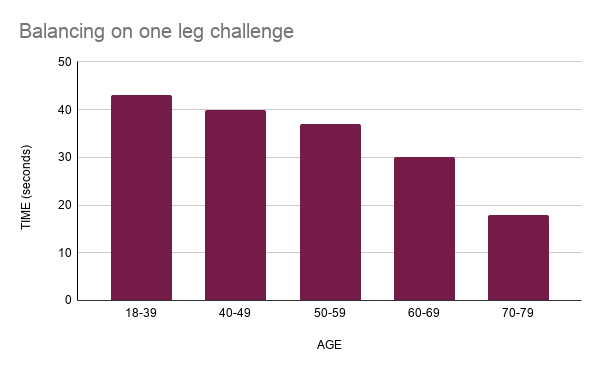
Chart shows target balance time relative to age
A lot of my clients come to me and have wobbly ankles, inflexible feet and stiff toes. That’s why I include foot and ankle mobility and strength work in every class. It was imperative for me in relearning to walk in a way that was less wobbly, and created less pain in other joints. Over time I have gained such strong appreciation for strong and flexible feet which help me move through the world comfortably and confidently. A strong foot will absorb more pressure so that your knees don’t have to, which in turn can help protect your hips, low back, and so on (the leg bone’s connected to the hip bone, after all!).
I’m interested in the full kinetic chain and will watch how you move in class to assess where any dysfunction might actually be coming from - whether it’s floppy feet (like me!), stiff hamstrings, weak hip flexors… And then we can work on your movement patterns and ease challenges over time.